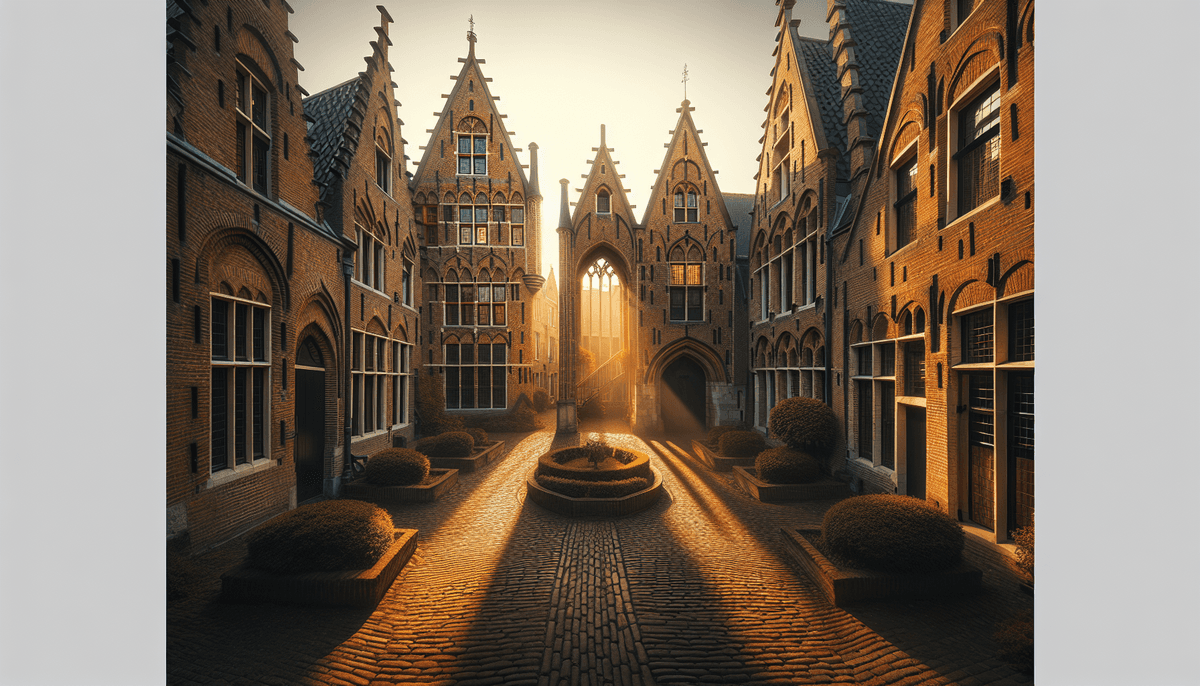
This comprehensive urban morphological examination elucidates Amsterdam's 17th-century socio-economic stratification through systematic analysis of the Jordaan's architectural palimpsest. Our methodological approach synthesizes historical cartography with contemporary spatial dynamics, revealing the complex syncretism between mercantile prosperity and religious tolerance that characterized the Dutch Golden Age. The itinerary encompasses fifteen strategically selected loci, including the paradigmatic Begijnhof—a medieval beguinage exemplifying ecclesiastical autonomy—and the Prinsengracht's quintessential canal-house typology, which demonstrates the sophisticated hydraulic engineering and urban planning methodologies employed during this period of unprecedented commercial expansion. The Anne Frank House serves as a critical nexus for understanding wartime spatial appropriation and clandestine domesticity. This moderate-intensity pedestrian investigation requires approximately 39 minutes of focused analytical engagement, facilitating deep contextual comprehension of Amsterdam's unique urban fabric through rigorous academic discourse and empirical observation.
Route
Stops on this tour
- 1Begijnhof
- 2Prinsengracht
- 3Oude Kerk Amsterdam
- 4Oude Kerk Amsterdam
- 5Oude Kerk Amsterdam
- 6Oude Kerk Amsterdam
- 7The Merchant House
- 8Anne Frank House
- 9Ons' Lieve Heer op Solder (Our Lord in the Attic Museum)
- 10Oude Kerk Amsterdam
- 11Orthodoxe Parochie van de Heilige Nikolaas van Myra te Amsterdam
- 12Royal Palace Amsterdam
- 13Royal Palace Amsterdam
- 14Royal Palace Amsterdam
- 15Royal Palace Amsterdam
Free · Audio narration · GPS-guided